


The rise of AI has completely transformed content production. Brands can now generate assets faster than ever, in larger volumes, and at a lower cost.
But this shift has created an unexpected side effect: more content hasn’t led to more impact.
If anything, it has made it harder for brands to stand out. Audiences are overwhelmed, increasingly skeptical, and often unsure of what to trust. The challenge is no longer about being visible, it’s about being believable.
In 2026, the real battleground is clear: credibility.
From Influence to Proof
For years, influencer marketing was built on carefully curated collaborations. The logic was simple: partner with the right profiles, control the message, and deliver polished content that reflects the brand.
For some industries, that model is now reaching its limits.
What audiences respond to today is not perfection, but authenticity. They are less interested in aspirational storytelling and far more receptive to real experiences, content that feels lived, not staged.
This explains a growing shift in performance. Increasingly, consumers trust content created by people who have genuinely used a product more than content designed to promote it. The difference is subtle, but powerful: one feels like advertising, the other feels like proof.
And in a world where AI can generate endless variations of the same message, proof becomes the differentiator.
The Authenticity Paradox
Most brands are aware of this shift. Authenticity is already part of nearly every marketing conversation. The difficulty lies in execution.
Authenticity doesn’t scale easily when approached with traditional marketing logic. The more a campaign is controlled, scripted, and standardized, the less authentic it appears. Yet letting go of control entirely isn’t a viable option either.
This creates a tension many teams struggle with: how do you create content that feels real, while still delivering consistent brand outcomes at scale?
The Authenticity System: A 3-Pillar Framework
To address this challenge, we developed what we call the Authenticity System: a framework designed to generate trust-driven influence in a structured and scalable way.
The idea behind it is simple: authenticity is not something you can fabricate upfront. It emerges from participation and behaviour.
The Authenticity System is built around three key pillars:
- Smart Selection
- Smart Prompting
- Smart Amplification
Each pillar plays a specific role, but together they solve the same equation: how to combine authenticity, control, and performance.
This approach is not theoretical. It is powered by platforms like trnd, which enable brands to activate large communities of consumers, observe real behaviours at scale, and transform participation into actionable insights. By structuring engagement from the very beginning, trnd makes it possible to operationalise authenticity without sacrificing scale or performance.
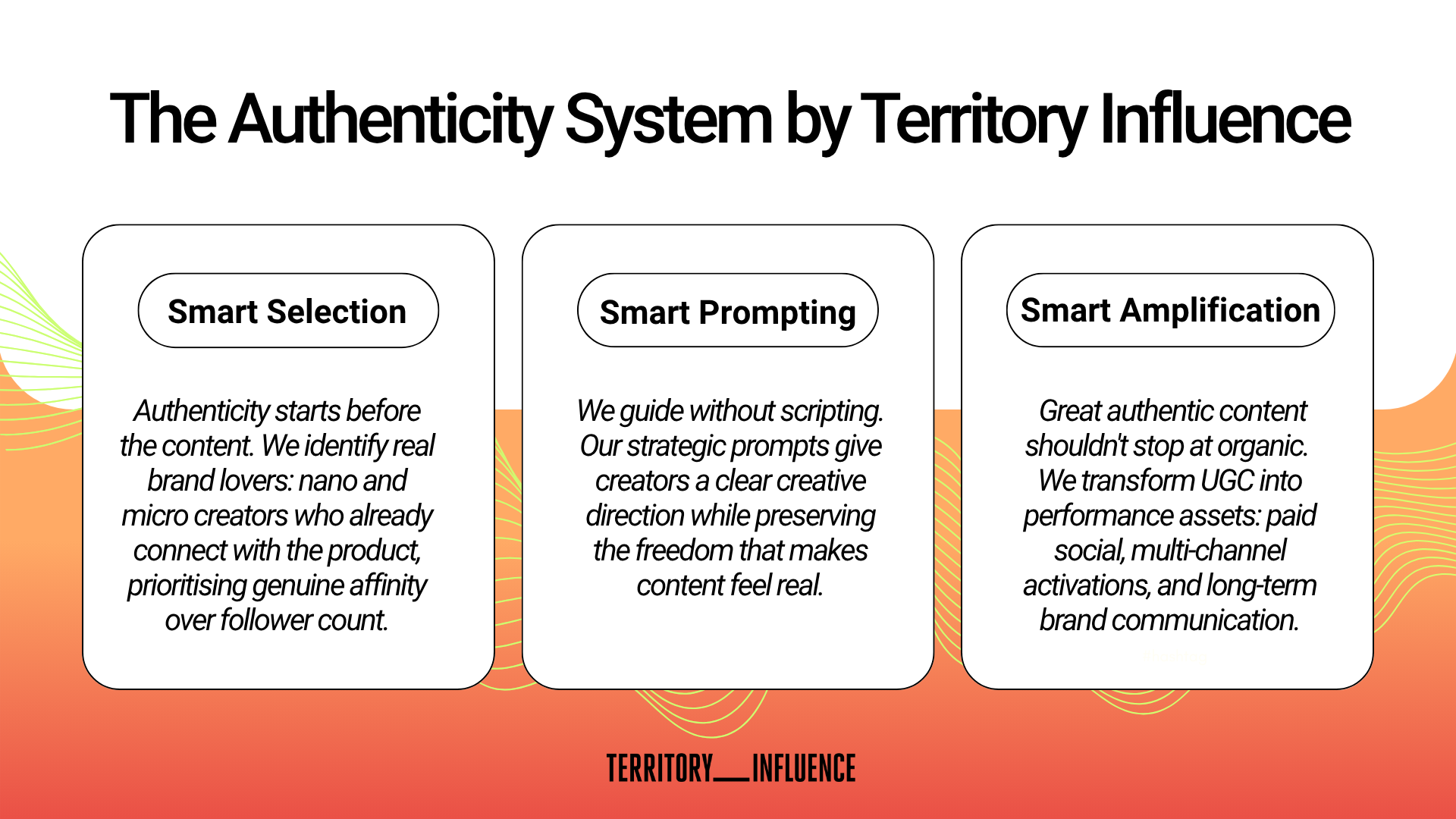
1. Smart Selection: It Starts With Who Creates the Content
Authenticity doesn’t start with content. It starts with who creates it.
Most campaigns don’t fail because of a bad brief, they fail because they rely on the wrong people. Too often, influencer selection is driven by reach, aesthetics, or surface-level affinities.
Smart Selection takes a different approach. Instead of starting with a fixed list of creators, we open participation to a broader group of relevant consumers and creators: people who already have a natural connection to the product or category. The goal at this stage is not to filter aggressively, but to create engagement and observe real behavior.
Participants are invited to interact with the brand through simple missions: sharing content, reacting, engaging. What matters is not just visibility, but involvement. Those who actively participate are already demonstrating intent. From there, selection is not based on assumptions but on what people actually do.
Who creates content that feels genuine without being over-directed?
Who engages in a way that is natural and relevant?
Who shows consistency and credibility in their interactions?
Early engagement becomes a behavioral validation layer, allowing us to identify the most credible voices in a real context—not on paper.
Of course, relevance still matters. Profiles are structured based on key criteria such as age, life stage, location, or lifestyle. But these signals are only the starting point. Because in this model, authenticity is not predicted. It is observed.
2. Smart Prompting: We Don’t Script. We Guide.
Once you have the right people, the question becomes simple: how do you get them to create authentic content without over-controlling it?
This is where most campaigns fall short. The instinct for many brands is to script, validate, and control every detail. But the more content is directed, the less credible it becomes.
Smart Prompting is built on a different belief: you don’t script authenticity, you create the conditions for it. Instead of giving rigid instructions, we provide structure, context, and substance. The goal is not to tell people what to say, but to give them everything they need to speak naturally. This approach is built in three steps.
First, education.
Before any content is created, participants need to understand what they’re talking about. That means giving them a clear view of the brand, the product, and the value it brings. We share key elements like brand story, product benefits, detailed information, and legal guidelines—not to control the message, but to ensure it is understood.
Then comes the experience.
We put the product in their hands and let it live in their daily life. They test it, they use it, and they share it with their close circle. We also capture their first impressions along the way. This step is critical. We don’t rush into content production, we let a real experience take place first. Because authenticity comes from usage, not instruction.
Finally, the creative mission.
And here again, the rule is simple: no scripts. We provide a direction (formats, ideas, sometimes interactive mechanics) but we leave room for interpretation. Participants express themselves in their own tone, with their own codes. That freedom is what makes the difference. It leads to content that is more spontaneous, more relatable, and more engaging.
At this stage, the role of the brand shifts. It no longer dictates the message, it creates the conditions for it to be credible.
3. Smart Amplification: Scale What Truly Resonates
Once you have authentic content, the next question is key: how do you make sure it doesn’t stay just… organic?
Authenticity is often seen as incompatible with scale. In reality, it simply requires a different approach. Too often, authentic content remains under-leveraged, limited in reach, short-lived in impact. But when something genuinely resonates, it shouldn’t stay a post. It should become a communication asset.
That’s the role of Smart Amplification. Instead of pushing all content equally, we identify what naturally performs: what feels real, engaging, and convincing because it reflects a genuine experience. These are the pieces that deserve to scale.
From there, amplification becomes strategic.
User-generated content is transformed into high-performing paid social assets, extending reach while preserving the authenticity of the original voice. It is also integrated into e-commerce environments (product pages, brand websites) where credibility directly impacts conversion.
Beyond digital, authentic consumer voices can be activated across broader touchpoints, from media placements to recommendation formats, ensuring consistency across the entire brand ecosystem. At the same time, reviews and ratings are distributed across platforms and channels, reinforcing trust while contributing to long-term SEO performance.
What emerges is no longer just a campaign, but a multi-channel ecosystem of real consumer voices, embedded into the brand’s communication. Because in this model, scale doesn’t come from producing more content. It comes from amplifying the right content.
From Content to Credibility: Why the Authenticity System Works
The effectiveness of the Authenticity System comes down to a simple truth: people trust people more than they trust brands.
While this has always been true, it has become even more pronounced in a landscape saturated with content that feels increasingly interchangeable. As AI continues to standardize outputs, the value of real, lived experience only grows stronger.
Consumers today are not looking to be convinced by perfectly crafted messages. They are looking to be reassured by something that feels real, something they can relate to and believe in. And that reassurance is what ultimately drives action.
This is why authenticity should not be seen as an abstract branding concept. It has very tangible business implications. It shapes how people perceive a brand, how they engage with its content, and whether they choose to trust it.
In that sense, authenticity is not opposed to performance, it is a key driver of it. The brands that succeed today are not those that produce the most content, but those that create the most credible content. Because in the end, visibility gets you seen. But credibility is what makes people act.
If you want to see real-life examples of the Authenticity System in action, let’s get in touch.