


Scrolling less. Living more. Posting about it anyway.
From journaling and scrapbooking to film cameras and MP3 players, a new wave of “going analogue” is taking over social media. At first glance, it looks like a rejection of digital. But look closer, and a more nuanced reality appears: people aren’t leaving platforms, they’re redefining how they use them.
For brands, this isn’t just a lifestyle shift. It’s a response to something deeper: content fatigue, declining trust, and a growing need for authenticity.
Why “going analogue” is rising now
The analogue comeback didn’t happen by chance, it’s a reaction to the current state of the internet.
Content has never been easier to produce. AI can generate visuals, captions, and entire campaigns in seconds. But more content hasn’t led to more impact. Instead, feeds feel saturated, repetitive, and increasingly difficult to trust.
According to recent consumer research, 94% of people say it’s harder than ever to know what is real online, highlighting a growing credibility gap in digital environments. In response, audiences (especially younger ones) are consciously reintroducing slower, offline practices into their daily lives: film photography, handwritten journals, vinyl records, phone-free moments, sending post-cards again.
This shift reflects a broader feeling that “the current version of the internet feels broken”.
This isn’t about rejecting technology. It’s about regaining control. People are becoming more intentional:
- Scroll sessions are shorter and more selective
- Engagement is more deliberate, less automatic
- Attention is treated as something valuable not infinite
The era of passive consumption is fading.
From lifestyle to aesthetic: the analogue paradox
Here’s where the trend becomes particularly interesting.
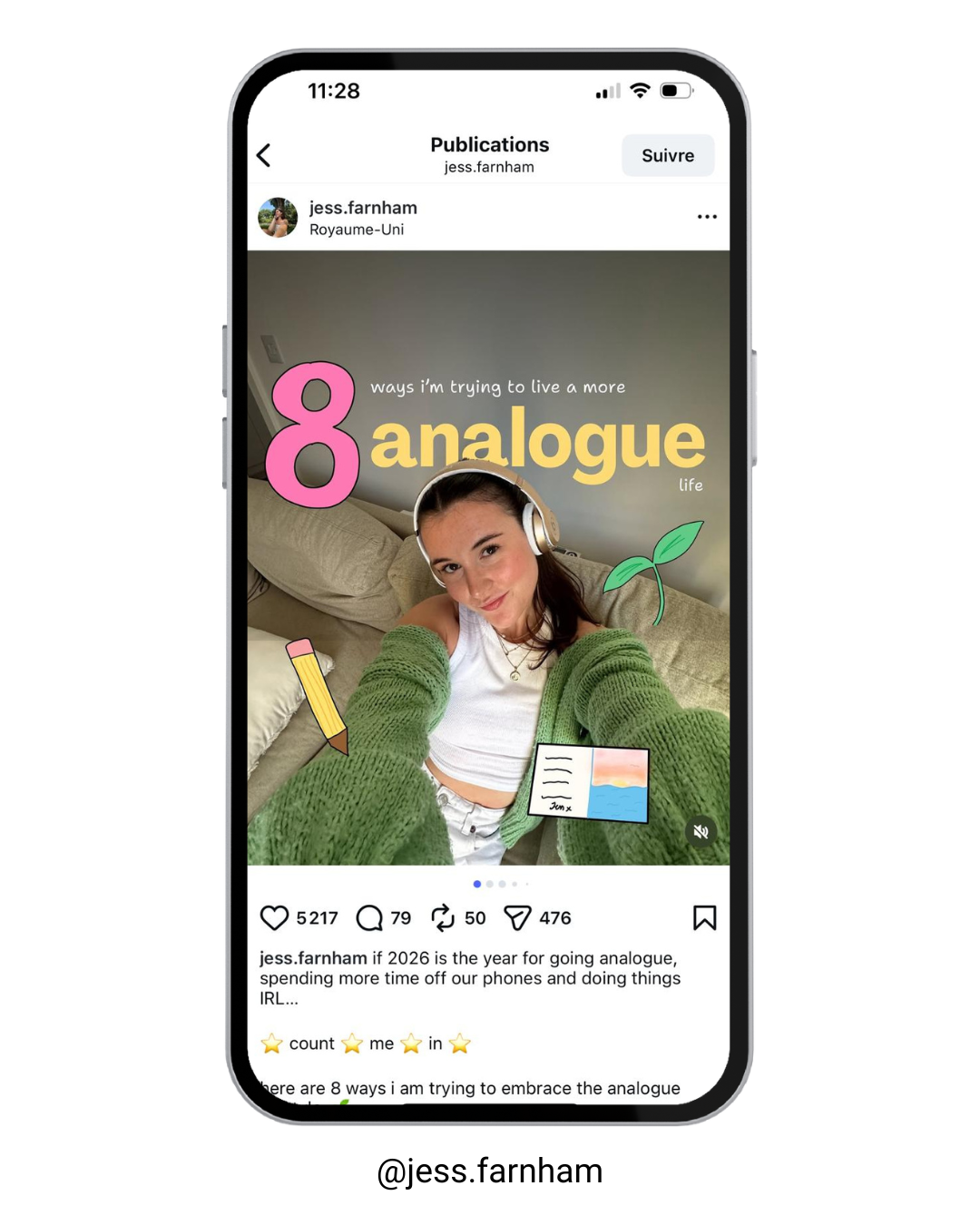
People say they want to disconnect… yet they continue to post about it. “Going analogue” has quickly evolved into a recognizable aesthetic: Scrapbook-style photo dumps, imperfect film photography, handwritten notes and layered visuals, “forgotten camera roll” content shared days or weeks later.
This type of content doesn’t feel produced, it feels collected. Personal, imperfect, real. And that’s the key shift. This movement isn’t about going offline entirely. It’s about bringing offline feelings into online spaces.
Even posting behaviours are changing. Real-time sharing is declining, replaced by delayed content that prioritizes lived experience over immediate documentation. So yes, people want to spend less time on their phones. But they still want to share, connect, and be seen.
What this means for brands
This trend challenges a core reflex in marketing: control. Because analogue-inspired content doesn’t work when it feels manufactured. You can’t industrialize imperfection or script authenticity.
But that doesn’t mean brands are excluded. It means their role needs to evolve. Building this kind of approach requires a shift in how influencer marketing is designed, from controlled campaigns to real consumer participation. (If you want to go deeper, we explored this in detail in our article on how to build authentic influencer marketing campaigns.)
1- Be part of real life, not just content
The opportunity isn’t to create “analogue-looking” campaigns. It’s to show up in real, offline moments. So when building your next campaign think about how you can integrate your product or service in moments like: journaling routines, cooking, reading, traveling, everyday product usage.
The objective shifts from visibility to real-life relevance.
2- Prioritize smaller, credible creators
Authenticity thrives in intimacy. Creators who genuinely live these behaviours, rather than perform them, are far more impactful. That often means:
- Smaller creators
- Niche communities (journaling, sewing, DIY, slow living, wellness…)
- Imperfect, personal storytelling
In this context, credibility matters more than reach.
3- Curate and amplify what resonates
Not everything needs to be planned. In a landscape where authenticity drives performance, the most effective strategy is often to observe what naturally resonates and scale it.
Some content stands out because it feels real, not optimized. Those are the assets worth amplifying:
- Through paid social
- On product pages
- Across owned channels
Scaling authenticity isn’t about producing more, it’s about recognizing what works and giving it reach.
4- Bring analogue… online
People aren’t abandoning social media. They’re redefining what they expect from it. They still want to scroll but differently: more human, more intentional, less polished.
This opens creative opportunities:
- Scrapbook-style formats
- Photo dumps instead of hero visuals
- Raw sequences over highly edited content
- Physical textures and handwritten elements
It’s not about rejecting digital codes but softening them.
5- Reconnect digital with tangible experiences
Another powerful signal: the return of physicality. From handwritten notes to zines and postcards, tangible elements are becoming central again. Because what people can hold, they remember. For brands, this can translate into:
- Physical assets shared with communities
- IRL activations with limited content capture
- Hybrid experiences combining offline moments and online storytelling (scrapbooking or painting sessions, cooking lessons…)
This isn’t anti-digital, it’s a reset
The biggest misconception would be to see this trend as a rejection of social media. It’s not.
This movement reflects a broader fatigue with sameness, overproduction, and hyper-optimized content. The analogue trend is less about going offline and more about redefining what feels valuable online.
Conclusion
“Going analogue” started as a way to disconnect. But like many cultural shifts, it quickly became content.
People journal and post it. They take film photos and share them. They disconnect and talk about it online.
That contradiction isn’t a flaw. It’s the point. The future isn’t offline or online. It’s both. And for brands, the opportunity is clear: don’t try to take people off their phones, make what they see feel more human.
This is exactly where approaches rooted in real consumer participation become essential. Platforms like trnd are built to enable this shift: activating real people, in real-life contexts, to generate authentic experiences that naturally translate into credible, high-performing content.
Because in the end, authenticity doesn’t come from how content looks. It comes from where it comes from.